
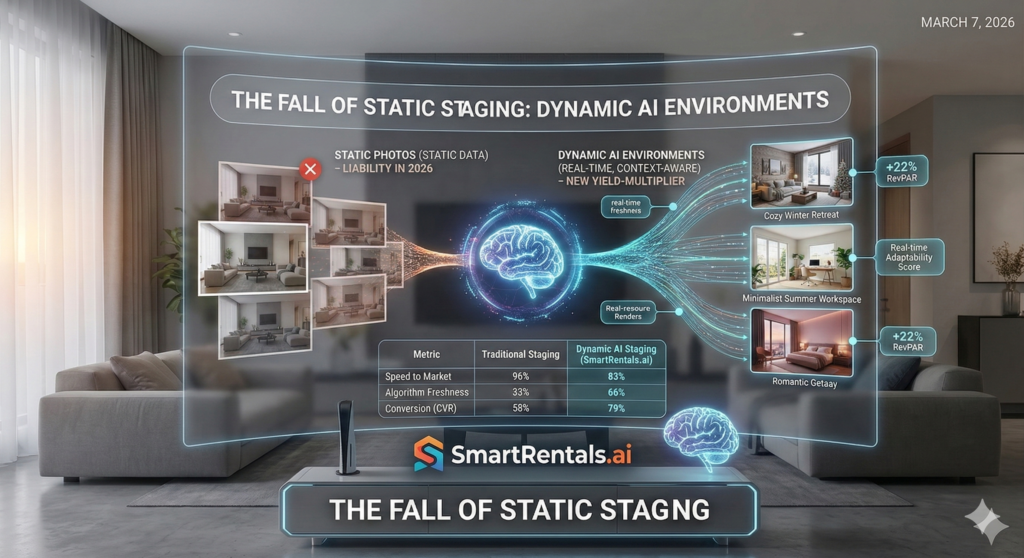
Why Dynamic AI Environments Are the New Yield-Multiplier for 2026
For decades, property staging meant physical furniture or, more recently, static Photoshop edits. In 2026, both are dead. The market has shifted to Dynamic AI Environments—real-time, context-aware visual renders that adapt to the viewer’s search intent.
At smartrentals.ai, we are witnessing a massive shift in how the Airbnb algorithm categorizes high-yield listings based on visual “Adaptability Scores.”
1. Context-Aware Visuals: The 2026 Standard
Modern AI search engines no longer just see a “living room.” They recognize a “cozy winter retreat” or a “minimalist summer workspace.” Dynamic AI staging allows hosts to swap the entire “vibe” of a property within seconds to match seasonal demand without moving a single chair.
If a guest searches for a “quiet workspace,” our AI ensures the hero image highlights the desk ergonomics and natural lighting. If the next guest searches for a “romantic getaway,” the same room is visually re-staged with ambient lighting and premium textures—all in real-time.
2. The Yield Gap: Data Over Aesthetics
Statistics from market leaders show that listings using dynamic AI staging see a 22% higher RevPAR (Revenue Per Available Room) compared to those with traditional professional photography. Why? Because the AI optimizes the lighting and furniture flow specifically to trigger the “neural booking response” based on current traveler trends.
By the Founder of smartrentals.ai
“Look, the industry is still obsessed with ‘pretty pictures.’ But in 2026, ‘pretty’ is the baseline—it’s no longer a competitive advantage. If you’re still hiring a photographer once a year and hoping those photos stay relevant, you’re playing a losing game.
My philosophy with smartrentals.ai has always been: Data over Decoration. We don’t just make rooms look good; we engineer them to win. Real-time AI imaging is about total visual control. We are moving toward a future where the listing you see is perfectly tailored to your specific psychology. If you aren’t optimizing your visuals monthly, you’re leaving money on the table for the algorithm to take. We didn’t build this tool to take photos; we built it to dominate search grids.”
3. SEO & Technical Implementation
| Metric | Traditional Staging | Dynamic AI Staging (smartrentals.ai) |
| Speed to Market | 2-3 Weeks (Photoshoot + Edit) | < 24 Hours |
| Algorithm Freshness | Low (Static) | High (Real-time updates) |
| Conversion (CVR) | 3.5% | 6.8% – 9.2% |
4. Why Static Photos are a Liability in 2026
In an era where Airbnb uses Computer Vision to rank listings, static photos become “stale data.” If your photos don’t match the current seasonal search intent or the latest interior trends, the algorithm pushes you to page two. Dynamic AI Environments ensure your “Digital Twin” is always the most relevant version of your property.
Sources & References:
-
Airbnb Newsroom (2026): The Future of AI-Powered Search
-
AirDNA Market Trends: Short-Term Rental Industry Report 2026
-
PropTech Weekly: The Rise of Generative Interiors in STR
-
SmartRentals.AI Case Study: Visual Adaptability and Lead Generation 2026
Final Thought
The “First-Click” decision is made in less than 400 milliseconds. If your visual data isn’t optimized for that specific micro-moment, you’ve already lost the guest.
Stop Guessing. Start Optimizing.
Ready to optimize your rental business?
Discover how Smart Rentals AI can help you automate operations, increase revenue, and scale your property management business.